
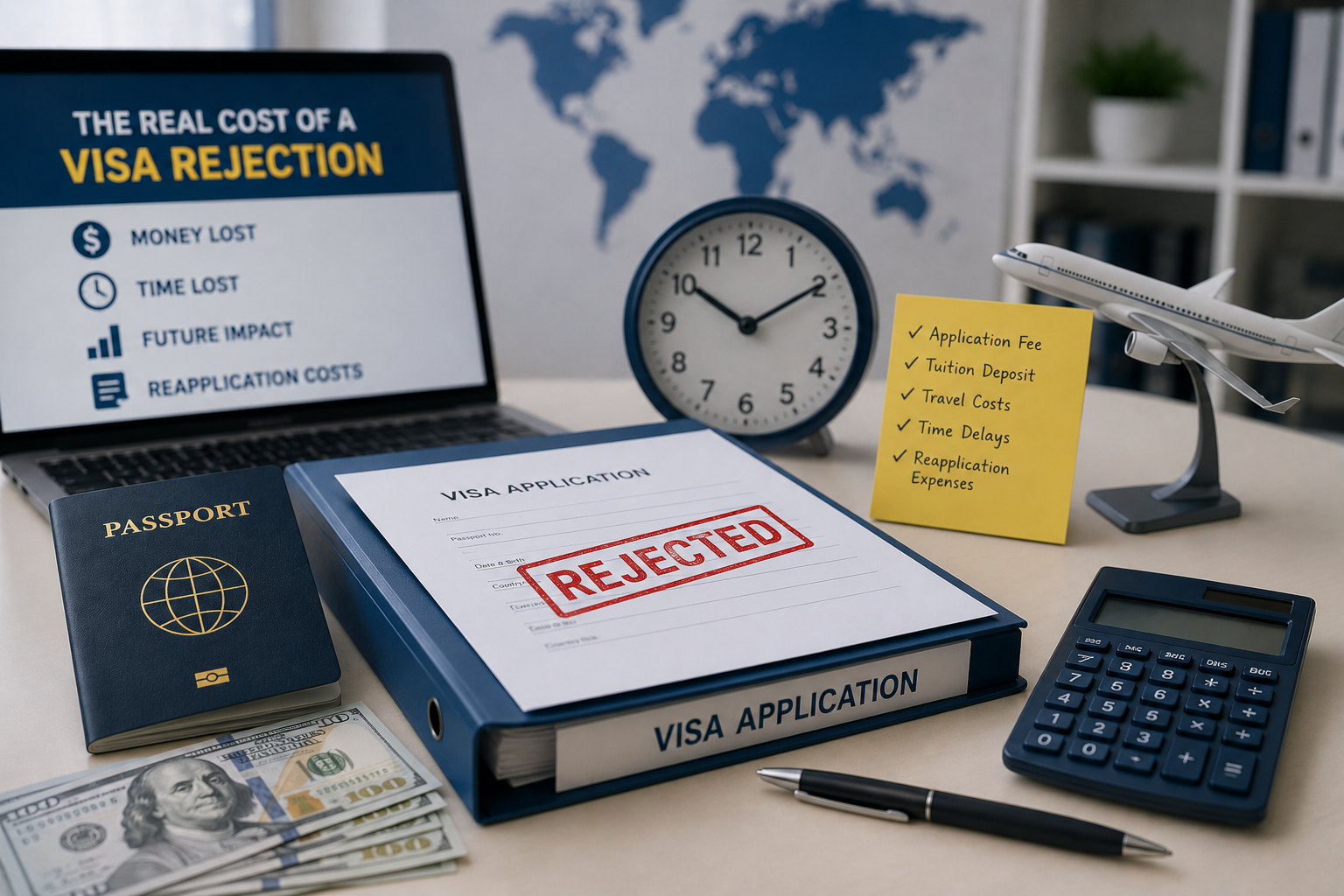
The Immediate Financial Hit
When your visa gets refused, the first losses are the most visible:
• Visa application fee (non-refundable in most countries)
• Biometrics and service charges
• Medical examination fees (if already completed)
• Courier and document attestation costs
• Consultant or agent fees (if you paid for a rushed or poor-quality service)
For popular destinations like Canada, the UK, Australia, or the US, these upfront costs can
easily add up to several hundred dollars, even before you factor in bigger losses.
The Hidden Costs Most Students Ignore
1. Lost Tuition Deposits
Many universities require a tuition deposit to issue your acceptance letter. Some
institutions refund this if your visa is refused, but others keep a portion (or all) of it. If
you've already paid a semester's tuition upfront, getting that money back can take weeks or
months, and some schools deduct administrative fees.
2. Delayed Intake and Lost Time
A refusal often means missing your intended intake. That's not just a few weeks, it can push
your start date by 4 to 8 months, depending on the next available intake. During that gap,
you might lose:
• A semester of academic progress
• Internship or co-op opportunities tied to your program timeline
• Scholarships or funding that were intake-specific
• Momentum in your career plan (especially if you took a break from work to study)
3. Reapplication Expenses
If you decide to reapply, you're paying again:
• New visa application fee
• Updated financial documents (bank statements, loan processing)
• Fresh medical tests (if the previous ones expired)
• Additional document translations or attestations
• Potential changes to your SOP or study plan with professional help
Students often underestimate how much a second attempt costs, both financially and
emotionally.
How a Prior Refusal Affects Future Visa Applications
This is where the real long-term cost shows up. A visa refusal creates a record in the
immigration system of that country. Here's what that means:
Canada
Canadian visa officers can see your prior refusal history. If your first application was weak
(ex:, unclear financials, inconsistent study plan), you'll need to address those gaps explicitly
in your next application. A second refusal without significant changes to your profile can
make future approvals much harder.
United Kingdom
UK Visas and Immigration maintains refusal records. Under the Genuine Student
requirement, officers scrutinize your academic progression and intent. A prior refusal
means your new application must clearly explain what changed and why you're now a
stronger candidate.
Australia
Australia's Genuine Temporary Entrant (GTE) requirement is strict. A previous refusal
triggers deeper scrutiny of your ties to your home country, financial capacity, and study
intentions. You'll need to provide a detailed statement addressing the prior refusal.
United States
US visa refusals (especially under section 214(b) for immigrant intent) stay on record. At
your next interview, the officer will likely ask about the prior refusal. Inconsistent answers
or unchanged circumstances can lead to another denial.
The pattern is clear: a refusal doesn't just cost you once, it raises the bar for every future
application to that country.
Real Scenarios: What Refusals Look Like in Practice
Scenario 1: The Rushed Application
Anne needed to leave for Canada in two months. She used a low-cost agent who submitted
her file quickly without thorough review. Her bank statements showed a large deposit two
weeks before submission, with no explanation. Result: refusal due to insufficient proof of
funds. She lost her fall intake, reapplied six months later with proper documentation, and
paid nearly double the original costs.
Scenario 2: Inconsistent Study Plan
David applied for a master's in data science in the UK, but his SOP mentioned career goals in
marketing. His academic background was in business, with no clear link to data science. The
visa officer questioned his genuine student intent. After a refusal, he worked with a
consultant to realign his SOP with his profile and reapply successfully, but lost a full
semester in the process.
Scenario 3: Multiple Refusals
Kate applied to Australia twice with similar documentation. Both times, her GTE statement
was generic and didn't address her ties to her home country. After two refusals, her third
application required extensive additional evidence and a detailed explanation of what had
changed. The process took over a year and cost three times the original budget.
How to Avoid These Costs
The best way to avoid the real cost of a refusal is to get it right the first time:
• Work with consultants who do a full profile audit before submission
• Ensure your financial documents are clear, consistent and well-documented
• Align your SOP and study plan with your academic and career history
• Address any prior refusals explicitly in new applications
• Don't rush, give yourself enough time for document review and corrections
A small investment in quality preparation upfront can save you thousands of dollars and
months of delay later.
Final Word
A visa refusal is more than a stamp on a letter. It's lost money, lost time, and a harder path
forward. Treat your first application as your only chance, because in many ways, it is. Get it
right the first time, and you'll save yourself far more than the cost of good advice.


Comments 0
No comments yet. Be the first to join the conversation!