
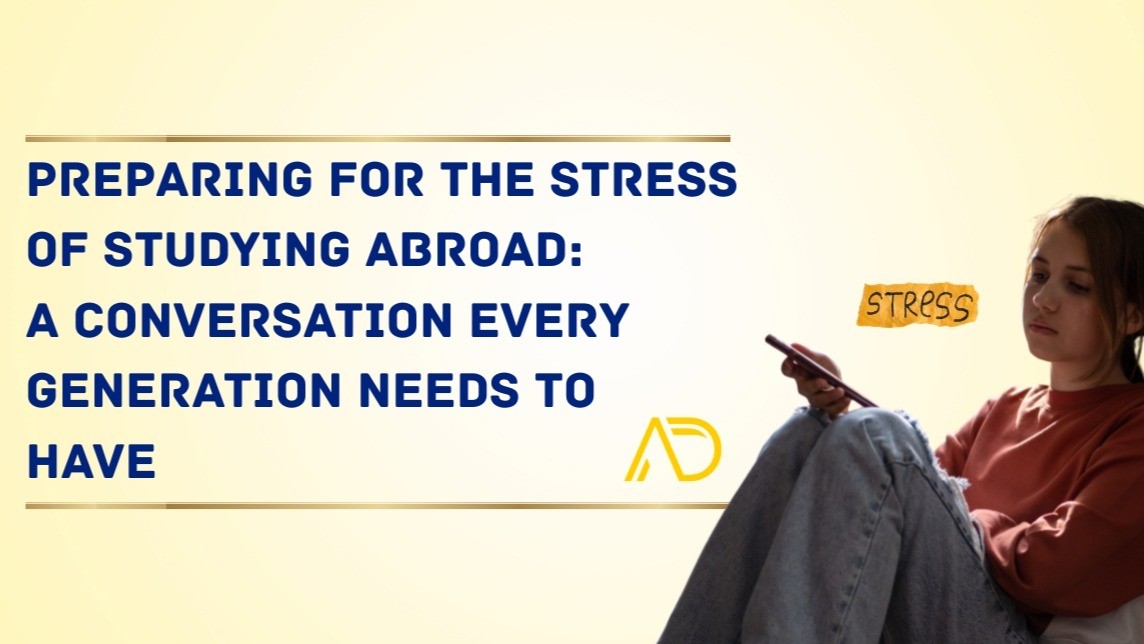
Ask a family why they want to send a son or daughter overseas to study and the answer is almost always the same: a better degree, a better career, a better life. Ask the same family how that son or daughter will cope with stress once they land, alone, in a country where they know no one, and the conversation usually stops. It is the question nobody plans for, and it is the one that decides whether the years abroad actually work out.
This is not a scare piece. It is a preparation piece. Stress abroad is real, it is measurable and it is manageable when a family goes in with open eyes instead of an agent’s sales pitch. Below is what the data actually shows, where families across generations tend to misjudge the risk, how false promises from unregulated agents make the problem worse and what correct preparation looks like.
Stress at home is the preview, not the exceptionA student who struggles with pressure, deadlines or homesickness at home will not suddenly develop new coping skills the moment they board a flight. If anything, the environment abroad removes the safety net that was quietly doing a lot of the work: parents nearby, familiar food, a language that requires no translation, friends who already understand the person without explanation.
Research on international students in Australia backs this up in hard numbers. A systematic review of studies on international student mental health found rates of psychological stress and distress between 31.6 percent and 54 percent, anxiety as high as 43 percent, depression as high as 38.3 percent and loneliness or isolation affecting 60 to 65 percent of students studied. A longitudinal study following Chinese international students in Australia found that acculturative stress, the strain of adapting to an unfamiliar culture and language, was directly linked to rising depression over their first months in the country. Comparative research has also found international students report significantly lower social support and more mismatched expectations than domestic students, even when their overall psychological distress looks similar on paper.
The pattern holds during shocks too. When COVID-19 disrupted travel and casual work, international students in Australia saw a sharper rise in depression, food insecurity and loneliness than local students did, because they had fewer people and fewer systems to fall back on. The lesson is not about pandemics specifically. It is about what happens to anyone whose support structure is thinner than they realized.
The question every generation gets wrong differently
“Are we prepared to handle stress at home” is really three separate questions, because the answer looks different depending on who in the family is being asked.The student going for their first degree, typically 18 to 22.This group tends to underestimate how much invisible labor their parents were doing at home, cooking, laundry, managing money, managing mood. They picture independence as freedom and skip past the fact that independence also means no one is checking in on them when a bad week turns into a bad month. Homesickness gets dismissed as something that will “pass,” and coping strategies get built for the first time under pressure instead of before departure.
The student going for a postgraduate degree while managing a career, a spouse or children back home.This group carries a different weight: financial pressure to make the move worthwhile, guilt about family separation and the stress of restarting professional credibility in a new country. Their stress is often invisible because they look like the “mature, capable” one in the family, which means fewer people check in on them at all.
The parents making the decision and funding it.Parents frequently focus almost entirely on cost, safety statistics and institutional ranking, all of which matter, while underestimating the emotional and practical readiness question. Many rely on an agent’s assurances as a substitute for having a direct, honest conversation with their child about how that child handles isolation, disappointment and setbacks. The agent’s job is to close an enrolment. It is not to have that conversation.
None of this means any generation is doing something wrong. It means each one is looking at a different part of the problem and assuming someone else has the rest covered.
Where it actually goes wrong: agents who promise more than they can deliver
This is the part families most need to hear plainly. A meaningful share of the damage done to students abroad does not come from the stress of a new country. It comes from being sent there on a false premise by someone whose income depended on the enrolment happening, not on the outcome.
The pattern shows up repeatedly in regulatory guidance and reporting:
• Australia’s skills quality regulator warns education providers to cut ties immediately with agents found giving unauthorized migration advice, engaging in dishonest recruitment or helping enroll students who will not meet their visa conditions.
• The Australian government has publicly acknowledged unscrupulous agents encouraging students to drop out of legitimate university degrees in favour of lower level courses that come with kickbacks, fee discounts or vague “migration pathway” promises, an issue serious enough that industry associations formally petitioned the government to close the loopholes.
• In 2023 the government moved to shut down roughly 150 vocational providers operating as what officials called “visa factories,” after students described being told their attendance and coursework would be “handled” while they worked full time instead of studying, on the promise that documents would be falsified for them.
• Investigative reporting has documented students paying agents thousands of dollars for visa help that turned out to involve fabricated advice, unauthorized individuals posing as consultants and payments routed through personal accounts with no accountability.
• Home Affairs itself warns that scam agents promote guaranteed visas, provide false documents or go silent once a decision has been made, tactics that specifically target the uncertainty families feel when they do not know the system well enough to spot the warning signs.
Here is why this connects directly back to stress. A student who arrives believing an agent’s promise of guaranteed permanent residency, an easy visa extension or a job waiting for them is a student who has built no real coping plan, because they were told there was nothing to cope with. When reality does not match the pitch, and it usually does not, the stress that hits is not just the ordinary strain of a new country. It is the shock of discovering the entire foundation of the decision was unstable, often with money and years already spent.
Families are right to worry about losing what they have invested. The way to protect that investment is not to avoid hard information, it is to get accurate information before the decision is made rather than after.
What correct preparation actually looks like
1.Separate marketing from evidence.Australia’s own Student Experience Survey collects data directly from enrolled students on teacher quality, learner engagement, skills development and overall satisfaction, institution by institution. Reviewing this kind of independent data before choosing a provider gives a family something an agent’s brochure cannot: an honest picture from people who actually studied there.
2.Verify the agent and the provider separately.Confirm the education agent has a documented, checkable relationship with the institution itself, not a third or fourth party referral chain. If migration advice is involved, confirm the individual is actually registered to give it. A legitimate agent will not discourage this kind of checking.
3.Build coping skills before departure, not after arrival.Basic independent living skills, budgeting, cooking, managing a bad week without a parent down the hall, are far easier to practise at home first. Waiting to build them under the added pressure of a new country makes everything harder than it needs to be.
4.Have the honest family conversation early.Parents and the student should talk directly about how that student handles isolation, disappointment and setbacks, before the flight is booked, not after a difficult phone call from overseas.
5.Plan for the real numbers, not the optimistic ones.Course fees, living costs, visa conditions and part time work limits should be confirmed against official sources, not an agent’s verbal estimate.
6.Know the support system on arrival.Every legitimate institution has a student support and counselling office. Knowing how to reach it before the first hard week arrives, rather than during it, makes a measurable difference.
7.Keep a second, independent point of contact for advice.Relying on a single agent as the only source of guidance throughout the entire process removes any check on bad advice. A second, verified perspective catches problems early.
Where Aascendora fits into thisAascendora was built around that last point specifically: no family should have to rely on a single agent’s word as the only source of truth for a decision this significant. Aascendora is a neutral marketplace that connects students and families to vetted, independently reviewed migration and education professionals, rather than funnelling everyone through one gatekeeper with one incentive. Families can compare verified professionals, see how they are rated by other students and choose based on evidence rather than a single sales conversation.
That structure does not remove stress from studying abroad. Nothing can promise that, and any platform that claims otherwise is making the same mistake this article is warning against. What it does is remove the specific risk of being misled into an unprepared, poorly matched or fraudulent pathway, which is the single biggest preventable driver of unnecessary stress once a student actually arrives. Preparation, honest information and a verified professional matched to the family’s actual situation are what turn “studying abroad” from a gamble into a plan.
The stress of a new country is real for every generation involved, the student, the parent funding it and the family holding things together at home. The right response is not to avoid that stress. It is to walk in with accurate information, realistic expectations and a verified support system already in place before the plane takes off.



Comments 1
--- 1. "Who We Serve" If your service doesn’t explicitly exclude a group (e.g., undocumented migrants, low-income families, or "unconventional" career paths), does that mean you’re actively serving them—or just pretending not to? What’s the ethical difference between a "universal" mission and a "don’t ask, don’t tell" one? --- 2. "International Migration Services" Is the global migration industry just a modern-day version of the slave trade—where desperate people pay for "passports" while corporations profit from their vulnerability? Why do we call it "services" instead of "exploitation"? --- 3. "Clients & Service Providers" What if the real "client" in this relationship is the government (or employer) paying for your services—while the actual migrant is just a transactional number? Who’s really in control of their future? --- 4. "Join as a Client" If you’re being sold a "guaranteed" visa or job, but the fine print hides a 90% failure rate, is that still "customer service"—or just a pyramid scheme disguised as immigration help? --- 5. "Find a Verified Professional" How do you "verify" someone who can’t be verified? If a consultant’s only credential is a LinkedIn profile and a $500 "certification," what’s stopping them from scamming you? Why do we trust "verified" over actual regulation? --- 6. "Join as a Professional" You’re selling hope to migrants—so why
Leave a Comment